

Education
What is a tulip setting?
The prongs curve up and open outward like petals, so the head holding your diamond reads as a flower rather than four bare claws. Here is how it holds a stone, which shapes suit it, whether it is secure, and what to check before you choose one.
The short answer
What a tulip setting is
A tulip setting is a prong setting whose basket has been shaped. Instead of four straight wires rising to grip the stone, the metal sweeps upward and flares outward in curves that meet at the girdle — the widest edge of the diamond — so that seen from the side the head resembles a tulip just beginning to open.
It is almost always a solitaire. The shaping happens in the basket, below and around the stone, which is exactly where most people never look on a plain setting. That is the point of it: a tulip gives you something to find later, from an angle only the wearer tends to see.
It is a style of head, not a style of ring. You can have a tulip basket on a slim band or a wide one, in any of our settings’ metals, holding almost any shape of diamond. What changes is the character: a plain prong solitaire is a stone and a band, while a tulip adds a second thing worth looking at without adding a single extra diamond.
The mechanics
How it holds the diamond
The prongs do the holding, as in any prong setting. The tulip shape is cut and formed into the basket that connects them — the structure sitting beneath the stone and above the band.
Two consequences follow, and they are the reason people choose this setting over a plain one.
The stone sits a little higher. A shaped basket has more height than a plain one, which lifts the diamond clear of the finger. More light reaches the pavilion — the underside, where most of a diamond's return comes from — and the stone reads larger than its carat weight suggests.
The underside stops being empty. On a plain solitaire the view from the side is a gap. On a tulip it is a shaped silhouette. This is the part that photographs well and the part a wearer notices for years afterwards.

The honest answer
Is a tulip setting secure?
This is the question people actually ask, so here it is answered plainly: a tulip setting is as secure as the prongs holding the stone, and the tulip shaping does not weaken them. The curved metal is structural. In most tulip baskets it adds material around the stone rather than removing it.
What genuinely affects security is the same list as for any prong setting:
- Prong count. Six prongs distribute the hold more evenly than four and are the safer choice for a round stone. Four give a cleaner look and more visible diamond.
- Prong thickness. Very fine prongs look elegant and wear down faster. This is a real trade-off, not a manufacturing flaw.
- Setting height. Anything raised catches on fabric more than a low or bezel setting. A tulip sits higher than a plain solitaire by design.
- Checking. Prongs on any ring worn daily should be looked at every year or two. That is true of a plain solitaire too.
If you work with your hands all day, or you already know you catch rings on things, the honest advice is that a raised setting of any kind asks more of you than a bezel. That is a reason to choose deliberately, not a reason to avoid a tulip.
Fit
Which diamond shapes suit a tulip setting
The basket has to be made for the stone. A tulip built for a round will not hold an emerald cut — the outline is different, so the petals meet the girdle in different places.

Round
The most forgiving. A round girdle is a circle, so the petals can be spaced evenly all the way around and the shape reads as a flower from every angle. If you want the tulip to be obvious, this is the shape that shows it best.

Oval
The most popular pairing we make, and the one that flatters the hand most. An oval is longer than it is wide, so the basket is drawn out to match. The petals at the points sit closer together than those at the sides, which gives the head a slightly tapered, more elegant look than a round.

Marquise
Dramatic, and the one that most rewards a shaped basket. A marquise has two sharp points that need protecting anyway, so the petals have a job to do as well as a look. The long outline and the upward sweep of the metal echo each other.

Emerald and Asscher
Step cuts have straight edges and corners rather than a curve, so the basket becomes rectangular and the petals read as corners rather than curves. The effect is more architectural than floral. Beautiful, but if you want the tulip to be unmistakable, a curved outline carries it better.

Pear
Asymmetric by nature, which the tulip handles well. The basket is wider at the rounded end and narrows to the point, so the shaping has a direction to it. The point needs a prong of its own regardless of setting style.

Cushion and radiant
Soft-cornered shapes sit between round and emerald. The basket keeps enough curve for the petals to read as petals, with corners that give the head a little more structure. A dependable middle choice.
Carat weight matters less than outline — see the 4Cs for how weight, colour, clarity and cut trade against each other. A tulip basket is made to the stone's measurements, so a 0.70ct oval and a 2.50ct oval both sit properly — the basket is simply built to scale. More on how each shape behaves.
Variations
Tulip with a hidden halo, and tulip cathedral
Tulip with a hidden halo. A hidden halo is a collar of small diamonds set around the centre stone's girdle, facing outward, invisible from above. Put one inside a tulip basket and the two ideas reinforce each other: both are details placed where only the wearer finds them. It adds sparkle to the profile view and makes the centre stone read fractionally larger. It also adds small stones to check over the years.
Tulip cathedral. A cathedral setting is one where the shoulders of the band rise in arches to meet the head, the way a cathedral's vaults rise to meet. Combined with a tulip basket, the whole structure lifts — arches from the band, petals from the basket. It is the most sculptural version of this setting and the one that most changes the silhouette of the ring.
Both are compatible with any of the shapes above. Both raise the setting slightly further, which brings the trade-off in the security section back into play.
Practical
Will a wedding band sit flush against it?
Usually yes, and more reliably than with many other styles. The tulip shaping happens above the band, in the basket, so the band itself is generally a plain or near-plain profile with nothing protruding at the point where a wedding band meets it.
Two things to check before you commit:
- Where the basket begins. If the petals sweep down low enough to reach the band, a straight wedding band may sit against them rather than against the ring. A small gap is normal and most people never notice it; if a perfectly flush fit matters to you, say so before the ring is made.
- Cathedral versions. Rising shoulders change the profile at exactly the place a band wants to sit. A contoured or notched band solves this, but it is worth deciding at the start rather than a year later.
We make every wedding band and setting to order, so if you already know which band will sit beside it, tell us and we will shape the two to meet.
Metal
Choosing a metal for a tulip setting
A shaped basket is a piece of visible metalwork, so the metal matters more here than on a plain solitaire where it is mostly hidden behind the stone.
Yellow gold shows the shaping most clearly. The warm colour reads against the white of the diamond, so the petals are unmistakable from the side. If the tulip is the reason you want the ring, yellow gold is the one that says so.
White gold and platinum let the setting disappear into the stone. The shaping is still there and still found by the wearer, but at arm's length the ring reads as a solitaire. This suits people who want the detail private rather than declared.
Rose gold sits between the two, warm enough to show the curves without the strong contrast of yellow.
Platinum is the densest of the four and holds fine prongs best over decades. White gold is finished with rhodium, which wears and is re-applied periodically; on a tulip basket there is more surface to re-finish than on a plain head.
Ours
The three tulip settings we make
Each is made to order in 14k or 18k gold or platinum, around a certified lab-grown diamond you choose yourself.
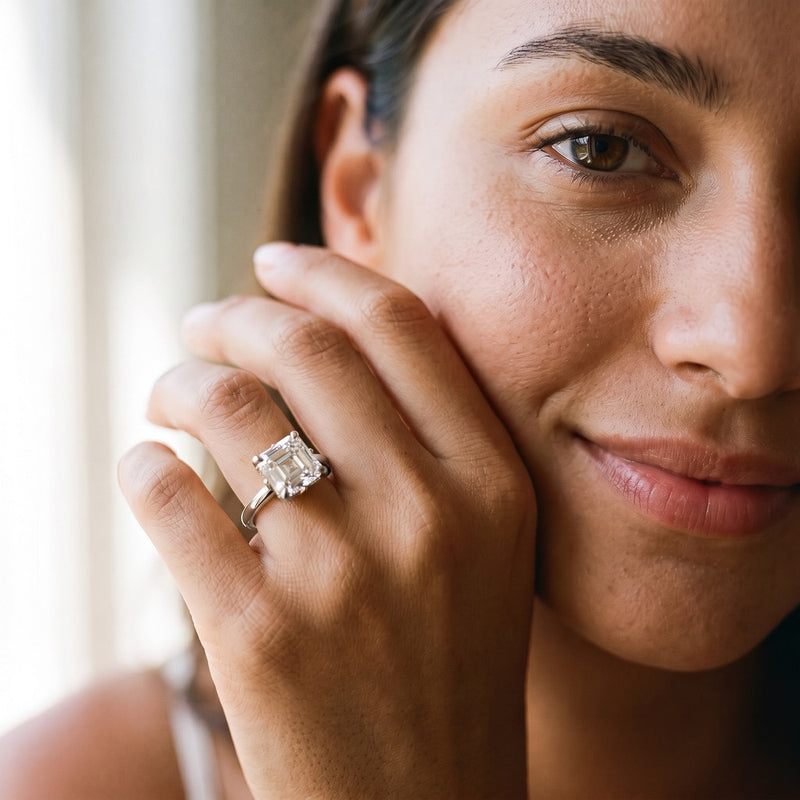
Tulip
The setting at its plainest: petals and a slim band, nothing else competing. The version to choose if you want the shaping to be the whole idea.
View Tulip
Sol
A fuller basket with a row of small diamonds beneath the centre stone, so the profile carries light as well as shape.
View Sol
Lyon
Diamonds set into the petals themselves. The most ornate of the three, and the one that reads brightest from the side.
View LyonQuestions
Common questions
What is a tulip setting on an engagement ring?
A tulip setting is a prong setting whose basket is shaped so the metal curves up and outward like the petals of an opening tulip. It is usually a solitaire, and the shaping sits below and around the diamond rather than on the band.
Is a tulip setting secure enough to wear every day?
Yes. The prongs hold the stone, and the tulip shaping does not weaken them — in most baskets it adds metal rather than removing it. What matters for security is prong count, prong thickness and having them checked every year or two, which is true of any prong setting.
What is the difference between a tulip setting and a plain solitaire?
A plain solitaire holds the stone on straight prongs with an open gap underneath. A tulip shapes that gap into a visible silhouette and sits the stone slightly higher. From above the two can look similar; from the side they are entirely different rings.
Which diamond shape works best in a tulip setting?
Round shows the shape most clearly and oval is the pairing we make most often. Marquise and pear suit it because their outlines echo the upward sweep. Emerald and Asscher give a more architectural, less floral result.
Will a wedding band sit flush against a tulip ring?
Usually yes, because the shaping sits above the band. Check where the basket ends, and note that cathedral versions may want a contoured band. Since every ring is made to order, we can shape the two to meet if you tell us at the start.
Does a tulip setting make the diamond look bigger?
It reads larger than the same stone set low, because the raised basket lets more light into the pavilion and lifts the diamond clear of the finger. The carat weight is unchanged — what changes is how much of the stone you see.
Can a tulip setting be resized?
Yes, within the usual limits for a ring with a shaped head. We include one complimentary resizing on qualifying engagement rings within six months of purchase.
Keep reading
Related guides
The engagement ring guide
Shape, setting, diamond and metal brought together, step by step.
Read the guideDiamond shapes
How each outline behaves, and which ones flatter the hand.
Compare shapesThe 4Cs
Carat, colour, clarity and cut, and where the money actually goes.
Understand the 4CsLab-grown diamonds
What they are, how they are graded, and why we use nothing else.
Read moreRing size guide
How to find a size without asking, and what to do if it is wrong.
Find a sizeHidden halo settings
The collar of diamonds that only shows from the side.
See the settingsStart with a tulip
Choose a setting, then choose the diamond that goes in it. Made to order, with one complimentary resizing within six months.
